

Short Answer
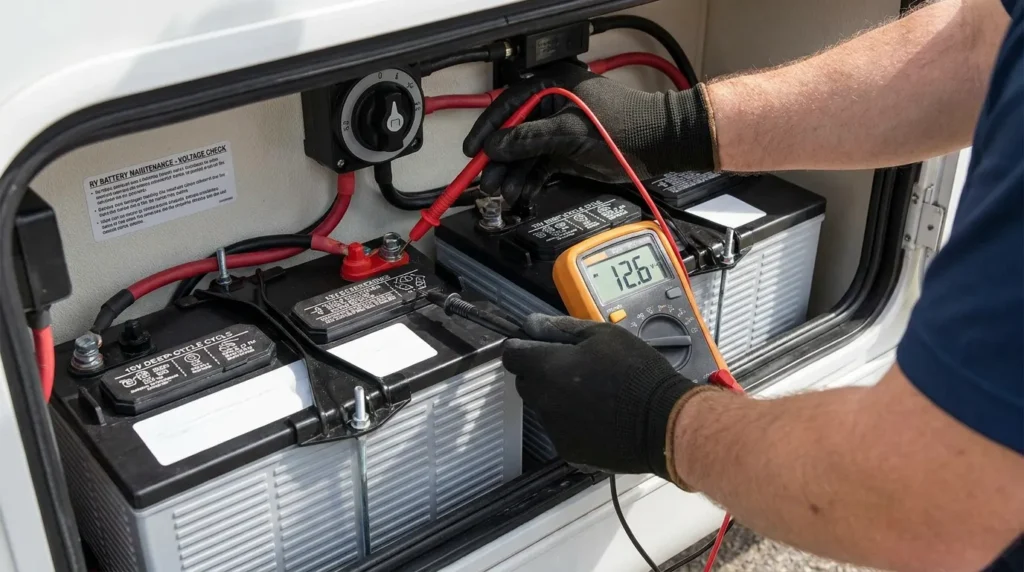
To test an RV battery with a multimeter, set the multimeter to DC voltage, connect the red probe to the positive terminal and the black probe to the negative terminal, then read the voltage. A healthy fully charged 12-volt RV battery typically reads between 12.6 and 12.8 volts when disconnected from a charging source.
Introduction
Your RV battery powers essential systems such as lights, water pumps, appliances, and electronic devices. When the battery begins to weaken, you may experience dim lights, slow appliance operation, or unexpected power loss.
Knowing how to test RV battery with a multimeter can help you quickly determine the battery’s condition before replacing expensive components. A simple voltage test often reveals whether the battery is healthy, undercharged, or nearing failure.
In this guide, you’ll learn how to safely test an RV battery, understand voltage readings, identify warning signs, and prevent future battery problems.
Real-World User Experience
Many RV owners first notice battery issues after their RV sits in storage for several weeks. Others discover problems when dry camping and appliances suddenly stop working despite believing the battery was fully charged.
In many cases, a quick multimeter test can identify the problem before it leaves you without power during a trip.
Quick Diagnostic Checklist
Before testing your RV battery, check the following:
✓ Turn off all RV electrical loads
✓ Disconnect shore power if possible
✓ Inspect battery terminals for corrosion
✓ Check for loose cable connections
✓ Look for swelling or physical battery damage
✓ Verify the battery is not actively charging
✓ Have a digital multimeter ready
Common Causes of RV Battery Problems
Low State of Charge
One of the most common reasons is simply an undercharged battery.
How to identify it:
- Low voltage readings
- Weak lights
- Slow appliance performance
Warning signs:
- Battery drains quickly
- Frequent charging needed
Sulfation
Lead-acid batteries develop sulfate crystals when left discharged for long periods.
How to identify it:
- Battery will not hold a charge
- Voltage drops rapidly
Warning signs:
- Reduced battery capacity
- Short runtime
Aging Battery
Most RV batteries gradually lose performance over time.
How to identify it:
- Battery older than 4–6 years
- Lower voltage after charging
Warning signs:
- Frequent power loss
- Poor charging performance
Corroded Connections
Corrosion can restrict electrical flow.
How to identify it:
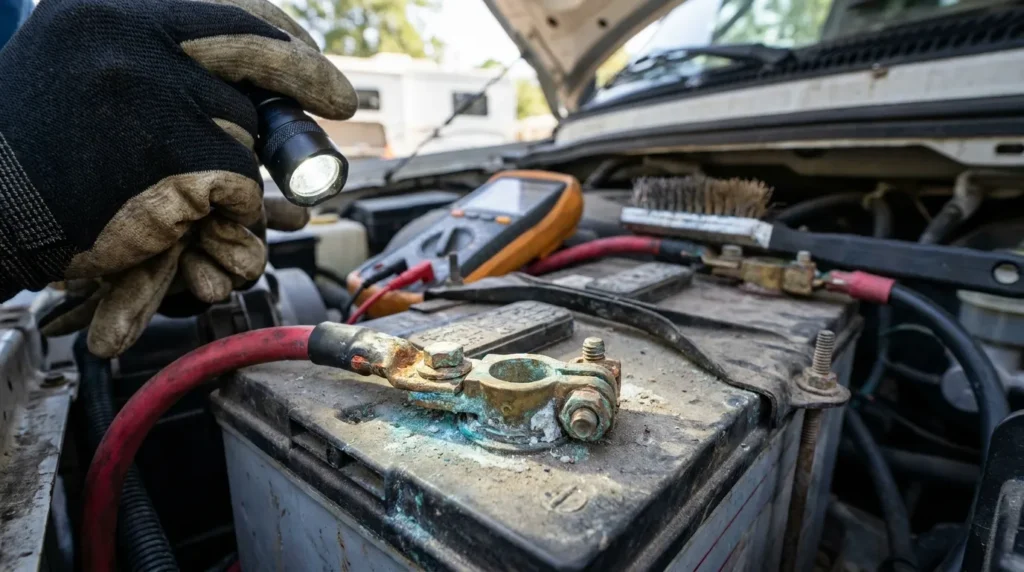
- White or green buildup on terminals
- Intermittent electrical issues
Warning signs:
- Inconsistent voltage readings
- Difficult charging
Signs and Symptoms of a Weak RV Battery
Watch for these common symptoms:
- Dim interior lights
- Appliances shutting off unexpectedly
- Water pump running slowly
- Difficulty starting generators
- Battery requiring frequent charging
- Voltage dropping rapidly under load
Early detection can prevent more expensive electrical problems later.
RV Battery Voltage Chart
| Battery Condition | Voltage Reading |
|---|---|
| Fully Charged | 12.6V–12.8V |
| 75% Charged | 12.4V |
| 50% Charged | 12.2V |
| 25% Charged | 12.0V |
| Discharged | Below 11.9V |
This chart applies to most 12-volt lead-acid RV batteries that have been resting without charging or loads.
How to Test RV Battery With a Multimeter
Step 1: Prepare the Battery
What To Check
Ensure the battery is disconnected from charging sources.
Tools Needed
- Digital multimeter
- Safety gloves
How To Fix It
Turn off shore power, solar charging, and generators if possible.
Expected Result
Accurate voltage reading.
Common Mistakes To Avoid
Testing while the battery is actively charging.
Step 2: Set the Multimeter
What To Check
Select DC voltage mode.
Tools Needed
- Digital multimeter
How To Fix It
Set the meter to 20V DC or the closest higher range.
Expected Result
Meter ready for testing.
Common Mistakes To Avoid
Using AC voltage mode.
Step 3: Connect the Probes
What To Check
Battery terminal polarity.
Tools Needed
- Multimeter probes
How To Fix It
Connect:
- Red probe to positive (+)
- Black probe to negative (-)
Expected Result
Stable voltage reading appears.
Common Mistakes To Avoid
Reversing probe placement.
Step 4: Read the Voltage
What To Check
Displayed voltage.
Tools Needed
- Multimeter
How To Fix It
Compare the reading with the voltage chart above.
Expected Result
Determine battery charge level.
Common Mistakes To Avoid
Interpreting charging voltage as resting voltage.
Step 5: Perform a Load Observation
What To Check
Voltage drop when lights or appliances are turned on.
Tools Needed
- Multimeter
How To Fix It
Monitor voltage while a moderate load is running.
Expected Result
Healthy batteries maintain voltage reasonably well.
Common Mistakes To Avoid
Assuming resting voltage alone guarantees battery health.
Also Read: RV Electrical Outlet Not Working but Breaker Not Tripped: Causes and Fixes
Related RV Electrical System Components
Understanding related systems helps with diagnosis.
Converter
Converts AC power into DC power and charges batteries while connected to shore power.
Inverter
Converts battery power into household AC electricity.
Charging System
Includes converters, solar controllers, and alternator charging circuits.
Fuses and Circuit Protection
Protect electrical components from overloads and shorts.
Electrical Wiring
Loose or damaged wiring can mimic battery failure symptoms.
Safety Precautions
Before testing:
- Wear safety glasses and gloves
- Avoid sparks near batteries
- Keep metal tools away from terminals
- Work in a ventilated area
- Never touch both terminals with a metal object
Seek professional help if the battery is leaking, swollen, or overheating.
How to Prevent RV Battery Problems
Follow these maintenance practices:
- Keep batteries fully charged during storage
- Clean terminals regularly
- Inspect cables every few months
- Use a battery maintainer during long storage periods
- Avoid deep discharges whenever possible
- Test battery voltage periodically
Preventive maintenance can significantly extend battery life and reduce replacement costs.
Related Problems & Internal Linking Opportunities
- RV battery not charging while plugged in
- RV converter not charging battery
- Deep cycle vs lithium RV batteries
- RV electrical outlet not working
- RV battery maintenance tips
Also Read: RV Battery Not Charging While Plugged In? Fix It Fast
When Should You Call a Professional?
Professional assistance is recommended when:
- Battery repeatedly fails testing
- Electrical wiring problems are suspected
- Charging system faults exist
- Battery overheating occurs
- Specialized load testing equipment is needed
A professional diagnosis can save time and prevent unnecessary parts replacement.
Common Mistakes People Make
Testing While Charging
This often produces misleading voltage readings.
Ignoring Corrosion
Corrosion can create electrical resistance and inaccurate test results.
Replacing the Battery Too Quickly
A simple charging issue can often mimic battery failure.
Using the Wrong Meter Setting
Incorrect settings can lead to confusion or inaccurate readings.
Not Performing Load Checks
A battery may show acceptable voltage but fail under load.
Also Read: Why Is My RV Battery Draining Overnight? Causes, Fixes & Prevention Guide
(FAQs)
1. What voltage should a healthy RV battery read?
A fully charged 12-volt RV battery typically reads between 12.6 and 12.8 volts at rest.
2. Can I test an RV battery without disconnecting it?
Yes, but readings may be affected by active loads or charging sources. Resting voltage provides the most accurate results.
3. How often should I test my RV battery?
Testing every month during active use and before major trips is a good practice.
4. Why does my RV battery show 12.6 volts but still not work?
The battery may have internal damage and fail under load. Additional load testing may be required.
5. How do I know if my RV battery is bad or just discharged?
Charge the battery fully, allow it to rest, and test voltage again. Rapid voltage loss often indicates battery deterioration.
6. Can a multimeter tell me battery capacity?
No. A multimeter measures voltage. Capacity testing requires additional testing methods.
7. What is the minimum voltage for an RV battery?
Most RV batteries are considered deeply discharged below 11.9 volts.
Conclusion
Learning how to test RV battery with a multimeter is one of the simplest and most useful RV maintenance skills. By checking voltage correctly, comparing results with a battery voltage chart, and watching for signs of battery deterioration, you can identify problems early and avoid unexpected power failures.
Regular testing, proper charging habits, and routine maintenance can significantly extend battery life. Before replacing an expensive battery, perform a thorough multimeter test and inspect related charging system components to ensure you’re addressing the real problem.